
'Challenge is basically near-term growth as the outlook has turned a bit adverse.'

Prime Minister Narendra Modi on Thursday said his government is using all channels including diplomatic to bring back high-profile economic offenders, leaving them with no option but to return to the country. Speaking at a symposium on credit flow and economic growth, he asked banks to support wealth and job creators with proactive lending while promising to stand by any loans given in right earnest. "In our attempt to bring back fugitive (economic offenders), we relied on policies and law and also used diplomatic channels.

India's economy is likely to grow by 6.5 per cent in the current and the next financial year, an EY report said, attributing lower than anticipated expansion in the September quarter to fall in private consumption expenditure and gross fixed capital formation. Real GDP growth eased to a seven-quarter low of 5.4 per cent in July-September -- the second quarter of the current 2024-25 fiscal year.

Economic reforms seem to be on a slow train, while good old fiscal populism is alive and flourishing.
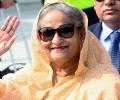
The Anti-Discrimination Student Movement (SAD), which led protests against Bangladesh Prime Minister Sheikh Hasina, has launched itself as a political party called the National Citizen Party (NCP). The new party, which aims to 'dismantle constitutional autocracy' and establish a 'second republic,' has pledged to create a 'solely Bangladesh-oriented' political system, with no room for 'pro-India and pro-Pakistan politics.' The NCP's inaugural rally was attended by representatives of various political parties, including the Bangladesh Nationalist Party (BNP), Jamaat-e-Islami, and envoys from the Vatican and Pakistan.

'Let us also not expect that there will be a clean break with the past, much though the new government might like to think about it. In a functional democracy that is neither feasible nor desirable. But basic change it must be,' says Shreekant Sambrani.
'GST will bring in much needed transparency and higher investments in the coming years and we hope that a few percentage points to India's GDP.'

Anticipating US action on tariffs, India seems to have made the first move by revamping its tariff structure by reducing the slabs to eight rates, points out Mukesh Butani.
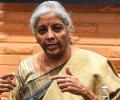
'The answer is not for me to give. The answer either way has to be heard from the industry itself. Tell us why not if you are not doing it; tell us if you are doing it -- why should this question remain unanswered?'

The Indian economy can contract by 7.7 per cent in current financial year ending on March 31 and the growth could be 11 per cent in the next financial year, according to the Economic Survey tabled in Parliament by Finance Minister Nirmala Sitharaman. The contraction in FY21 is mainly due to coronavirus (Covid-19) pandemic and the visible damage caused by the subsequent countrywide lockdown to contain it. The survey unveiled two days before the Union Budget is broadly in line with forecasts by the Reserve Bank of India (RBI) which has said it expected the country's GDP to contract by 7.5 per cent in the year ending March 31.

We have a government with an extremely weak economic team advising a PM who hardly pays attention to their thoughts, says Jayanta Roy.
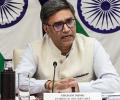
The United States has approved the extradition of Tahawwur Rana, accused of involvement in the 2008 Mumbai terror attacks, to India. The decision was announced by President Donald Trump during a joint press conference with Prime Minister Narendra Modi in the White House. India is currently working on the logistics of Rana's surrender and extradition, with several final steps to be completed before he is sent back to India. The joint statement issued by India and the US during Prime Minister Modi's visit reaffirmed their commitment to fighting terrorism and eliminating terrorist safe havens. The leaders also called on Pakistan to bring to justice the perpetrators of the 26/11 Mumbai and Pathankot attacks. Rana, a Canadian national of Pakistani origin, is currently lodged at a metropolitan detention center in Los Angeles. He is associated with Pakistani-American terrorist David Coleman Headley, one of the main conspirators of the 26/11 attacks.

Dalal Street minnows stole the show in 2024, giving handsome returns to investors, helped by a largely optimistic trend in the stock market and impressive retail investors' participation. Analysts attributed the positive trend in the equity markets, where the benchmark indices shattered many records this year, to robust domestic liquidity, strong fundamentals of the Indian economy, and policy continuity.

RBI's interest rate decision, quarterly earnings and global cues would be the major driving factors for equity markets this week, analysts said adding that the impact of the Union Budget could linger on this week. Trading activity of foreign investors will also be a key driver for the markets, experts noted. "US and India's manufacturing PMI for January to be released on Monday, will be the key macro data to watch out for.
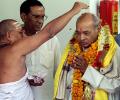
It is thanks to the policy of liberalisation conceived by Manmohan Singh and enforced by P V Narasimha that the Indian economy has now become the world's 5th largest economy by nominal GDP, asserts Dr Sudhir Bisht.
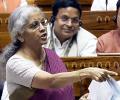
'Is the Agniveer scheme or their post-retirement re-employment in paramilitary forces or in the state governments the BJP's answer to the crying need on the job front?' 'Or, even Finance Minister Sitharaman's one-year internship scheme in the public and private sector, is it a permanent solution, either?', asks N Sathiya Moorthy.

Reserve Bank Governor Shaktikanta Das on Thursday said the fundamental drivers of the Indian economy are gaining momentum and the country is moving on a sustainable growth path. In the inaugural address at FIBAC 2024, the governor said that massive changes are taking shape in various economic sectors and markets, and the country is geared for orbital shifts.
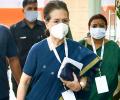
The Congress president also announced that a compact task force will be set up to drive the process of internal reforms that are essential.

India on Friday made a strong pitch for a sovereign rating upgrade with Moody's and also questioned the parameters based on which the US-based agency accords ratings, sources said on Friday. Ahead of its annual review of the sovereign rating, Moody's Investors Service representatives met Indian government officials during which the officials highlighted the reforms and strong fundamentals of the Indian economy. A higher rating for India would mean the nation is less riskier, translating into lower interest rates on borrowings.
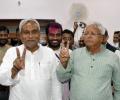
The government needs to take positive action to reaffirm that story.

The outcome may determine whether Macron's centrist coalition retains power or if France faces a period of political cohabitation with the far-right National Rally, led by Marine Le Pen.
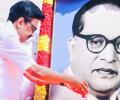
Given the possibilities that next year's assembly elections could throw up, Stalin told the state assembly that an interim report had to be submitted by January 2026. The outcomes may well find its way into the DMK's poll manifesto, thus seeking to keep the electoral focus still on the BJP-ruled Centre and Prime Minister Modi, observes N Sathiya Moorthy.
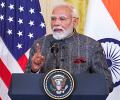
Those who stay in other countries illegally do not have any legal right to be there, Modi said.

Chief Justice of India J S Khehar on Saturday criticised the electoral politics in the country, saying poll promises are "routinely unfulfilled", caste issues projected differently to get a majority and party manifestos do not have any linkage to socio-economic justice.

India supports dialogue and diplomacy and not war, Prime Minister Narendra Modi said at the Brazil, Russia, India, China, South Africa (BRICS) Summit in Kazan, Russia on Wednesday, in an unambiguous message calling for resolution of the Russia-Ukraine conflict through peaceful negotiations.
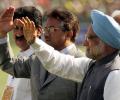
Jammu and Kashmir Chief Minister Omar Abdullah has said that India and Pakistan came closer to resolving the Kashmir issue during the Manmohan Singh-led UPA government. He added that he does not expect a return to that situation in his lifetime. Abdullah lauded Singh's efforts on Kashmir, including the setting up of working groups on the issue, and said he practically initiated measures for the return of displaced Kashmiri Pandits. The chief minister also praised Singh's contribution to India's economic development.

The Finance Minister Pranab Mukherjee on Monday tabled the Economic Survey for 2008-09 that prescribes doing away with cess, surcharges on taxes, including Fringe Benefit Tax, and sweeping refroms in areas like petrol pricing and financial sector.

Dr T V Somanathan is the first finance secretary to be appointed Cabinet secretary since 1985. His appointment at this juncture seems to carry much meaning for the forthcoming trajectory of reforms and restructuring of India's steel frame.
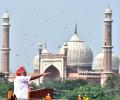
Entry of a higher number of technocrats, an appraisal system for civil servants and the benefits of changing the financial year may feature in the PM's fourth speech.

The Union government is expecting to rake in Rs 100-200 crore in additional revenue from Pillar Two, only under specific circumstances, a senior finance ministry official said requesting anonymity. It is proceeding cautiously, and is unlikely to implement rules anytime soon, the source said.
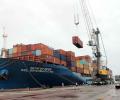
Industry associations and companies in the United States, including the US Chamber of Commerce, Coalition of Services Industries and the iconic bike company Harley Davidson have called on the Donald Trump dispensation to push India to reduce tariffs, non-tariffs, and regulatory barriers to boost American exports.

'When manufacturing or even services cannot generate the kind of employment they are looking for, they prefer to be unemployed rather than under-employed.'

Industry body CII on Thursday made a case for pushing reforms in sectors like land, labour, and agriculture by the Modi 3.0 government to accelerate economic growth, which is estimated to be around 8 per cent in the current financial year. CII president Sanjiv Puri said a lot of policy interventions in the past have put the economy on "a much stronger wicket". "The growth rate is poised to touch 8 per cent during the current year, marking the fourth consecutive year of above 7 per cent + growth.

Bibek Debroy was one of the very few economists not bound by any single area of expertise and was simultaneously curious about economics and politics, myths and maths, chess and chemistry, and what not, remembers Laveesh Bhandari.
In a veiled attack on Bharatiya Janata Party's opposition to FDI in retail, Home Minister P Chidambaram on Tuesday said political parties which believe that the country should go ahead with economic reforms should neither change their stand nor be apologetic about it.

International Monetary Fund (IMF) Deputy Managing Director (MD) Gita Gopinath has condemned the "terrible and disturbing" incident of rape and murder of a trainee doctor in Kolkata. "Personally, it is terrible to have any event of this kind. It is disturbing," she told Business Standard in New Delhi.

Finance Minister Nirmala Sitharaman's Budget proposals lay out a comprehensive road map for transforming India into a developed nation, focusing on key priorities that aim to generate ample opportunities for all citizens in "Viksit Bharat". It sets the stage for sustained economic growth, social development, and technological advancement.
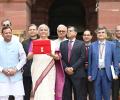
With the reality of coalition politics staring the BJP in its face, this was inevitable, points out Ramesh Menon.
The National Democratic Alliance won 64 seats.
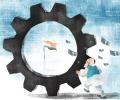
There are instances -- both from national and state elections -- of economic under-performers being returned to power, and also of parties being thrown out despite good performance, observes T N Ninan.
